Escutcheonectomy Before and After: Pubic Lift Results From Dr. Mark Solomon, a Board-Certified Plastic Surgeon With 30+ Years of Experience, Hundreds of Procedures, and a Graft-Free Native-Skin Technique
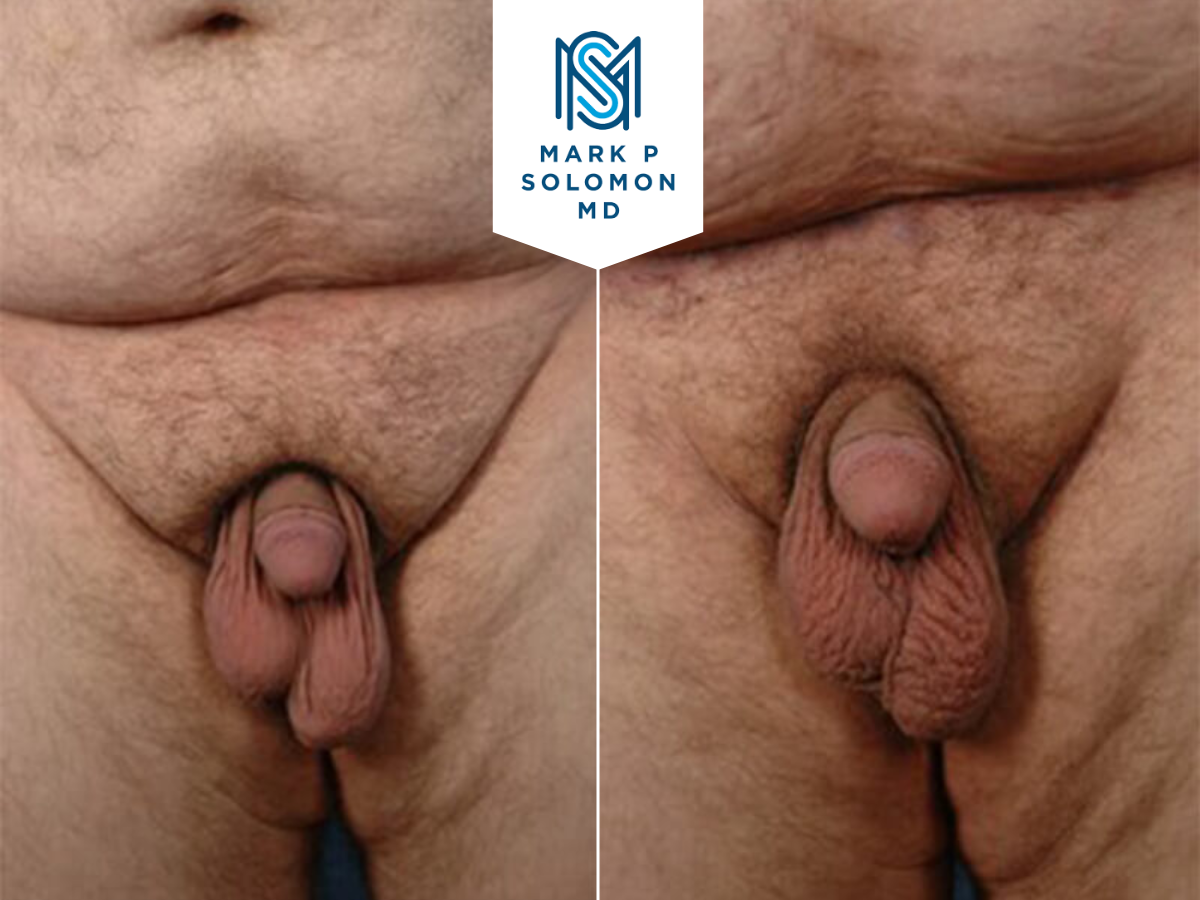
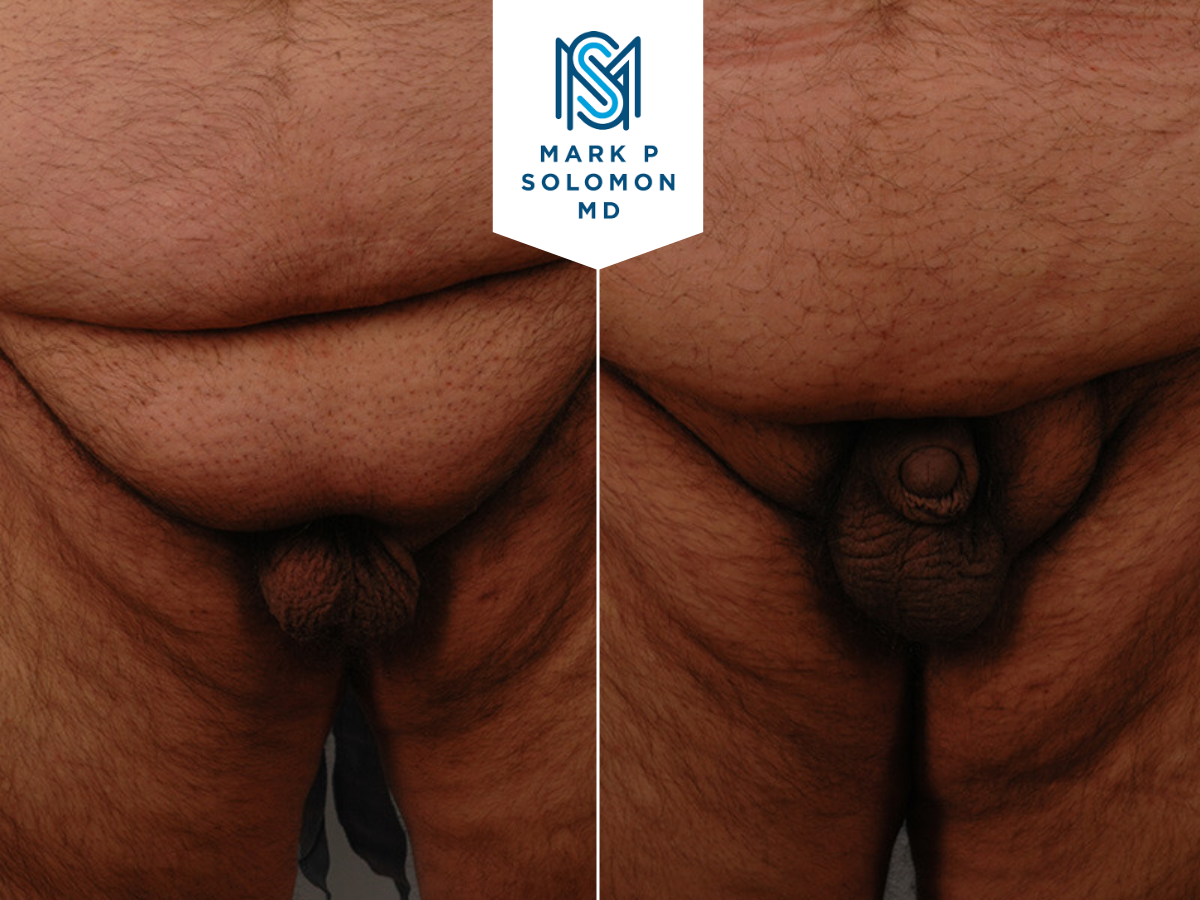
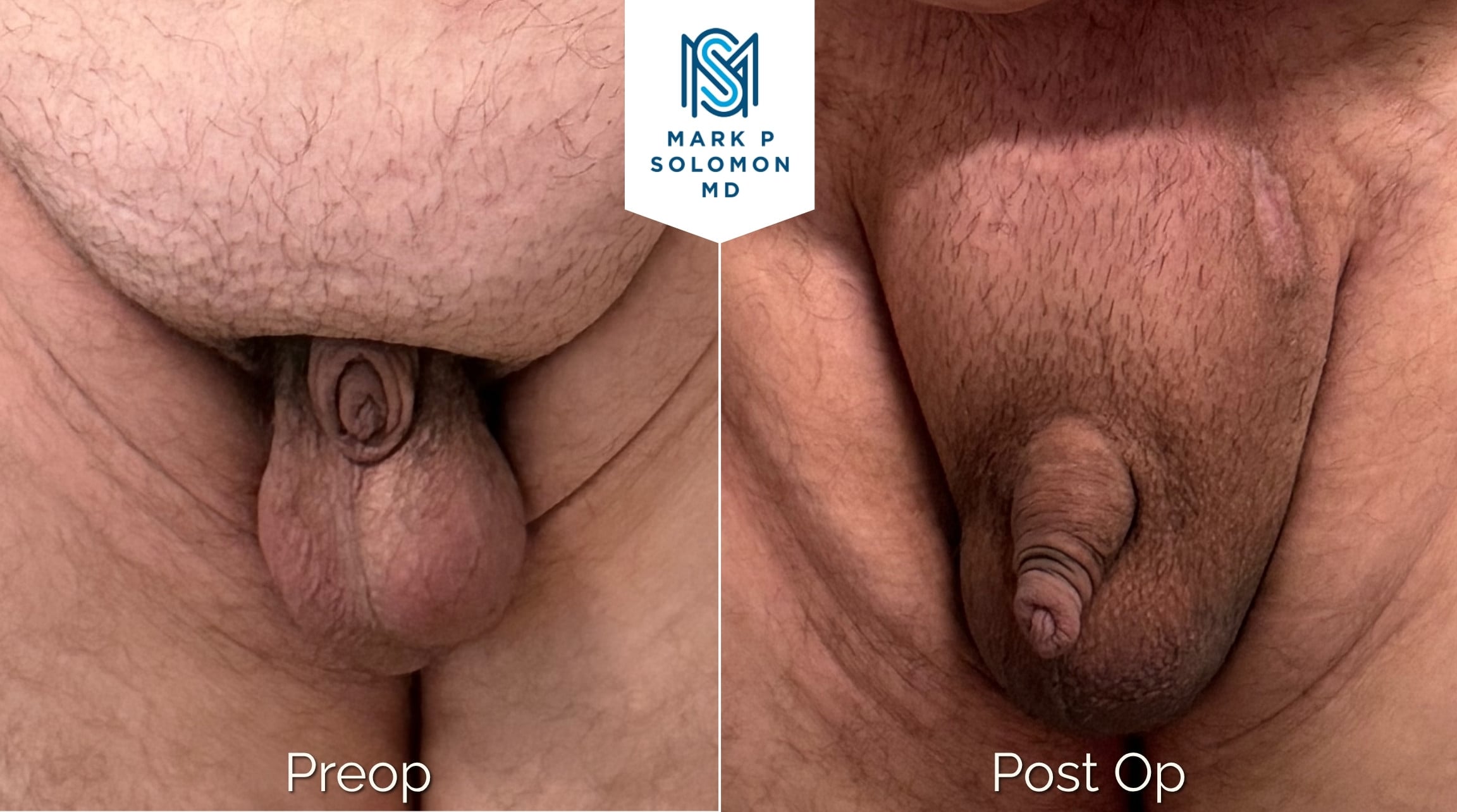
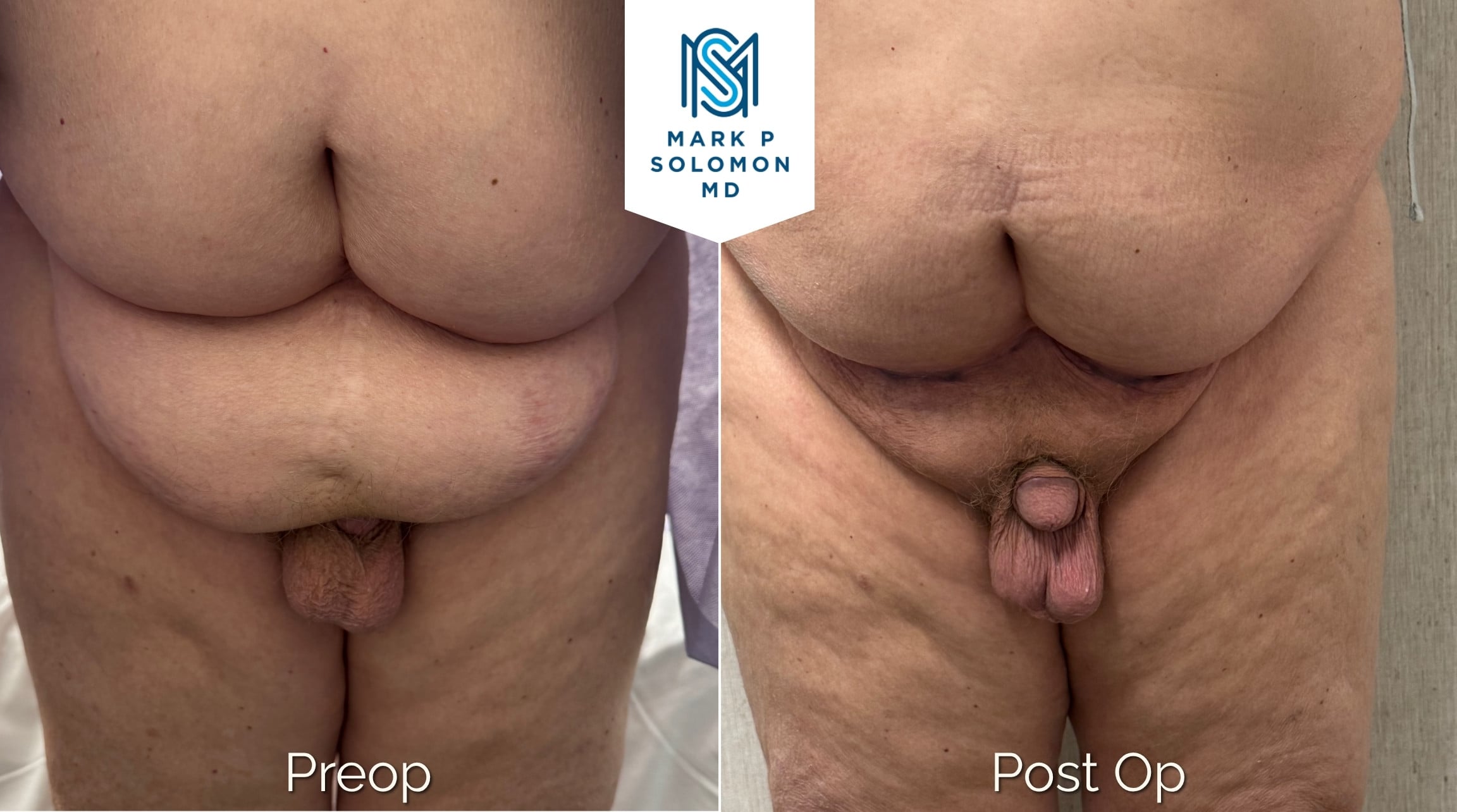
A pubic lift (escutcheonectomy) removes the excess pubic skin and fat that hide a buried penis. Before photos show the penis partly or fully hidden beneath an overhanging pubic mound; after photos show a flatter pubic area and a visible shaft. The penis is uncovered rather than enlarged, and results vary.
This gallery shows escutcheonectomy before and after results for men with adult acquired buried penis (AABP) who wanted surgical repair to improve both function and appearance.
The most common causes are excess pubic skin and fat left behind after major weight loss, weight-loss surgery such as gastric bypass, or newer GLP-1 weight-loss drugs like Ozempic® and Wegovy®. That tissue can trap moisture, create hygiene problems, make urination difficult, and make penetrative intercourse DIFFICULT or impossible.
Dr. Solomon is a board-certified plastic surgeon with more than 30 years of experience. He performs the pubic lift (escutcheonectomy) to remove the overhanging tissue and expose the penile shaft, which can make HYGIENE and urinating easier.
These cases show patients who underwent pubic lift surgery with Dr. Mark Solomon to expose hidden penile length and refine the pubic contour. Click any photo to view the case at full size with the procedure details and outcome.
Buried penis surgery does not treat erectile dysfunction. Individual results vary, and we discuss your expected outcome at your consultation. For a breakdown of the factors that shape your fee, see Dr. Solomon’s guide to escutcheonectomy cost.
Key Takeaways
- A pubic lift (escutcheonectomy) removes the excess pubic skin and fat that hide the penis in adult-acquired buried penis (AABP).
- Common AABP causes include weight gain, major weight loss, weight-loss surgery, and newer weight-loss drugs (GLP-1s).
- Buried penis repair can improve hygiene, urination, and difficulty having penetrative intercourse. It does not treat erectile dysfunction.
- Dr. Solomon, a board-certified plastic surgeon, preserves your native shaft skin and uses no skin grafts.
- Each before-and-after photo shows one person’s result, and results vary from patient to patient.
- Surgery is outpatient, and Dr. Solomon sees patients at their hotel every day for the first three to five days.
How Should You Read Escutcheonectomy Before-and-After Photos?
This gallery is intended for adults 18 and older. It contains unedited clinical photographs of male genital surgery.
Compare escutcheonectomy before-and-after photos as matched clinical pairs taken from the same angle and under consistent lighting, with the postoperative recovery stage clearly stated. This helps you distinguish surgical changes from differences caused by the camera or swelling that has not yet settled.
Each photo is labeled by presentation to help you find cases like yours, such as post-weight-loss, newer weight-loss drugs (GLP-1s), or complications from a cosmetic implant placed elsewhere. Labels also name the techniques used, such as pubic lift (escutcheonectomy), suction lipectomy with a cannula, or telescoping correction.
When you look at each pair, check three things:
- How much of the penile shaft is now visible
- How much pubic fullness has been reduced
- Where the incision sits, and whether the native shaft skin was preserved with no grafts
Dr. Solomon places the incision low, where the abdomen meets the pubic area, similar to a C-section scar. Photos taken in the first weeks after surgery can still show swelling and bruising, and the final contour takes several weeks to months to appear.
When a caption names a recovery point, read the photo against that point: an image from the first month shows early healing, while an image from several months out shows a contour much closer to the final result. The incision line also matures over time: a scar that looks pink in an early photo usually flattens and fades as the months pass.
Dr. Solomon has performed hundreds of hidden penis revision procedures with a high success rate over many years of practice. Results vary, and we discuss expected outcomes at your consultation. You can view more cases in the pubic lift photo gallery.
Escutcheonectomy Before and After Significant Weight Loss
After gastric bypass, or after losing weight from morbid obesity, the stretched pubic skin does not shrink along with the fat. The weight comes off, but the loose tissue stays behind and keeps the penis buried.
Newer weight-loss drugs leave the same pattern. Dr. Solomon’s practice sees men whose excess skin followed GLP-1 medications such as Ozempic®, Wegovy®, or Mounjaro®, as well as bariatric surgery.
That leftover tissue is more than a cosmetic concern. A review in the Central European Journal of Urology notes that the overhanging skin creates an environment that encourages bacterial and fungal growth, and that recurrent infections then perpetuate the problem by causing skin contractures and scarring. Each round of infection and scarring can tether the skin further, which makes hygiene harder and intercourse more difficult.
That is also why weight stability matters before a pubic lift (escutcheonectomy). Dr. Solomon evaluates whether your weight has settled before planning surgery, because ongoing loss can loosen the pubic skin again after it has been tightened. Ongoing gain can refill the fat pad the surgery removed.
Major weight loss also weakens the tissue that holds the shaft skin in place. After massive loss, the attachments between the penile shaft skin and the underlying tissue are often weakened or lost, which lets the skin slide forward over the head of the penis. Loose scrotal skin and penoscrotal webbing are also common, and Dr. Solomon can correct scrotal redundancy and webbing during the same procedure.
The after photos in this section show pubic lift (escutcheonectomy) combined with suction lipectomy of the pubic area. Together, these steps remove the excess skin and fat and bring the shaft back into view.
Dr. Solomon keeps the native shaft skin and uses no grafts. How much improvement each man sees depends on skin elasticity, the amount of scarring, and how he heals.
Before and after: pubic lift (escutcheonectomy) with suction lipectomy following significant weight loss. Results vary.
Pubic Lift (Escutcheonectomy) Before and After Suction Lipectomy
Dr. Solomon performs suction lipectomy with a cannula (a small tube used to remove fat cells) to reduce excess fat in the mons pubis. The pubic lift then removes the excess pubic-area skin to expose the penis.
Using both steps addresses the two main reasons the penis is hidden: fat volume and overhanging skin. Suction lipectomy can also be done as a standalone procedure for men with primarily fatty tissue, while men with both excess fat and loose skin usually need both steps.
The change between photos is often dramatic. In before images, the shaft may be hidden beneath a rounded, full mons pubis. After treatment, the mons pubis is flatter, and the penile shaft is exposed.
Dr. Solomon keeps the patient’s own shaft skin and uses no skin grafts, so the visible change comes from removing tissue rather than replacing it. Preserving native skin helps protect sensation and blood supply.
Before and after: pubic lift (escutcheonectomy) with suction lipectomy. Results vary; individual outcomes differ.
Escutcheonectomy Before and After Abdominoplasty or Panniculectomy
A hanging lower-abdominal apron can press down on the pubic area and add to the burial. This is common after major weight loss, weight-loss surgery, or newer weight-loss drugs (GLP-1s).
Dr. Solomon adds abdominoplasty to the pubic lift (escutcheonectomy) only when the abdomen is contributing to the burial. An abdominoplasty removes excess abdominal skin and fat and tightens the abdominal muscles.
Many men need only a pubic lift. When both are needed, doing them together has a practical benefit: a single operation avoids staged procedures and creates a smoother contour from the abdomen through the pubic area.
A panniculectomy is a different operation. It removes hanging skin and fatty tissue from your abdomen, but it does not tighten your muscles like a tummy tuck. Panniculectomy appears here only as a comparison term, to make the surgical difference clear.
Insurance may cover part of the procedure when it is medically necessary, because insurers treat cosmetic and reconstructive surgery differently. Documentation of hygiene problems, skin breakdown, INABILITY TO HAVE INTERCOURSE or trouble urinating can help support that review.
Before and after: pubic lift (escutcheonectomy) with abdominoplasty. Results vary.
Escutcheonectomy Before and After Cosmetic Penile Implant or Filler Complications
Some men develop scar tissue and retraction after a cosmetic subcutaneous silicone penile implant. These changes can involve both the penis and the pubic area, leaving the penis looking buried and making it harder to function.
Dr. Solomon removes cosmetic silicone penile implants, including all components and any associated materials such as mesh, when present. He does not place or revise them. He has more than 15 years of experience treating men with penile-implant issues.
Part of what makes these cases complex is the body’s own response to the device. A capsule is scar tissue that forms around any foreign body, and around a subcutaneous implant, that capsule can tighten and pull on the penis and pubic area.
The mesh used to attach these implants lies close to the nerve to the head of the penis, and removing it calls for careful technique. In Dr. Solomon’s experience, some patients who have lost sensation regain it after mesh removal; results vary.
Dr. Solomon also corrects complications from fat transfer or fillers placed by other doctors. He does not offer fat transfer or fillers.
Where the burial involves the pubic area, a pubic lift (escutcheonectomy) combined with native-skin preservation brings the penile shaft back into view without skin grafts. In contrast, the shaft skin keeps its own nerve and blood supply.
Before and after: cosmetic implant or filler complication correction with pubic lift (escutcheonectomy). Results vary; individual outcomes differ.
What Is the Escutcheonectomy Procedure, Step by Step?
The escutcheonectomy procedure, step by step, removes excess pubic fat and skin, exposes the buried penile shaft, stabilizes the shaft skin when needed, and closes the area while preserving the patient’s native shaft skin. Dr. Solomon performs these steps based on your anatomy, so the exact surgical plan can vary from one patient to another.
How a pubic lift differs from a classic escutcheonectomy
The two terms are often used interchangeably, and insurers classify the procedure as an escutcheonectomy, but the operations are not identical.
A classic escutcheonectomy removes virtually all of the skin of the pubic area, often through a wide incision across the center of the pubic mound. A pubic lift removes only the excess pubic skin and contours the area to a more natural appearance.
Dr. Solomon treats buried penis repair as a reconstructive body-contouring procedure. He places incisions low in the crease between the lower abdomen and pubic area rather than across the center, which helps create a cleaner contour and a discreet scar. That is why this page uses both terms together: pubic lift (escutcheonectomy).
Before surgery
Dr. Solomon begins every case with a preoperative evaluation. It typically includes medical clearance for anesthesia, blood work, blood pressure control, diabetes screening to confirm stable blood sugar, and an electrocardiogram for men aged 50 or older. You will also be guided on pausing blood thinners, aspirin, ibuprofen, WEIGHT LOSS MEDICATIONS, or supplements that can increase bleeding.
On the day of surgery
At the accredited outpatient facility, Dr. Solomon will make precise surgical markings and take clinical photos for planning and documentation. An IV line is placed, a physician anesthesiologist meets with you, and the procedure will take place under general anesthesia. Surgery time depends on your anatomy and how many steps your case requires.
- Fat Reduction With Suction Lipectomy: When needed, Dr. Solomon first reduces excess pubic fat with suction lipectomy, removing fat through a small cannula placed through a discreet incision. This step targets the pubic fat pad that helps bury the penis and drives many of the hygiene problems seen in adult-acquired buried penis.
- Skin Removal: Next, Dr. Solomon removes the excess pubic-area skin and fat to uncover the buried penile shaft. The incision sits in the fold between the abdomen and pubic area, which keeps the scar discreet.
- Shaft-Skin Stabilization: With the shaft exposed, Dr. Solomon pulls the shaft skin back and uses fixation sutures to anchor the skin to the fascial layer of the penis. This corrects telescoping, where the skin slides forward over the head of the penis, and helps keep the shaft visible during recovery and afterward.
- Drain Placement (When Needed): Depending on how much tissue is removed, Dr. Solomon places small surgical drains in some cases to prevent fluid buildup. He shows you how to care for them and removes them within a few days.
- Closure and Native-Skin Preservation: Dr. Solomon uses dissolvable sutures, which means there are no stitches to remove later. At every step, he keeps the patient’s own shaft skin, along with its nerve and blood supply, and uses no skin grafts. The surgery is outpatient, and you go TO A RECOVERY HOTEL OR RECOVERY FACILITY the same day.
What Is a Buried Penis, and What Does It Look Like?
A buried penis is a normally developed penis hidden beneath excess pubic fat and skin, so the penile shaft may appear partially or completely concealed within the surrounding tissue. It is not a small penis. Adult acquired buried penis (AABP) develops when the pubic fat pad and overhanging skin cover the shaft, often after significant weight gain or loss, weight-loss surgery, or newer GLP-1 weight-loss drugs.
Visible signs of adult acquired buried penis include:
- A penile shaft that disappears into the pubic fat pad
- Pubic skin that hangs over the base of the penis
- Loose shaft skin that slides over the shaft (telescoping)
- Moisture or irritation trapped in the skin fold
Urinary symptoms and difficulty having penetrative intercourse are among the most common complaints. The Central European Journal of Urology review, which drew on 18 studies, cites a clinical series that described lower urinary tract symptoms as being the most common presenting complaint, including trouble directing the stream, hesitancy, post-void dribbling, and incontinence. Buried penis surgery does not treat erectile dysfunction.
Compare these signs with the before-and-after photos to see how a pubic lift (escutcheonectomy) uncovers the penis. Results vary with case complexity and individual factors.
The condition also affects how men feel about themselves. The same review lists low self-esteem and depression among the presenting symptoms of buried penis, and many men describe avoiding intimacy, locker rooms, or medical appointments. Recognizing that the problem is physical and treatable is often the first step toward a consultation.
What Causes Adult Acquired Buried Penis (AABP)?
Adult acquired buried penis develops when surrounding tissue gradually covers the penile shaft, and several causes can work together.
- Obesity and weight gain: Morbid obesity and weight gain enlarge the suprapubic fat pad, which pushes forward and hides the penile shaft. A Central European Journal of Urology review notes that obesity is the most common cause in adults.
- Major weight loss: After massive weight loss from gastric bypass or newer GLP-1 weight-loss drugs, the excess pubic skin and fat usually do not shrink back on their own. This makes AABP a common side effect of successful weight loss, not a sign that the weight-loss treatment failed.
- Scarring conditions: Lichen sclerosus (also called balanitis xerotica obliterans) creates scar tissue that tethers the shaft skin. A prior circumcision can trap the penis the same way when the suture line tightens after surgery and forms scar tissue.
Circumcision history matters here too: when the problem is loose shaft skin sliding forward, doing another circumcision often aggravates the issue, which is why repair focuses on stabilizing the shaft skin instead.
- Recurrent infections: Bacterial and fungal infections in moist skin folds cause scarring, and the same review reports that recurrent infections perpetuate the problem by causing skin contractures and scarring. The burial can worsen even without further weight gain.
- Genital lymphedema: Genital lymphedema causes swelling in the scrotal and penile tissue, which buries the shaft.
Which Symptoms Can Escutcheonectomy Improve?
Escutcheonectomy can improve hygiene problems, urinary symptoms, difficulty with penetrative intercourse, and reduced penile visibility caused by adult-acquired buried penis (AABP). A pubic lift (escutcheonectomy) removes the excess pubic skin and fat that bury the penis. How much each symptom improves depends on your anatomy and the complexity of your case, and results vary.
The procedure may help with:
- Trapped moisture and recurrent infections: Removing the overhanging skin reduces the warm, moist fold where bacteria and fungi grow, which may lower the rate of skin and urinary tract infections.
- Trouble aiming the urine stream: A buried penis is hard to direct, and exposing the shaft often makes urination easier to control. Many men regain the ability to urinate standing once the shaft is exposed.
- Post-void dribbling: Leakage after urinating often improves once the penis is visible and easier to keep clean.
- Difficulty having penetrative intercourse: The same review explains that erections may be painful due to stretching of the overlying skin, which is immobile and can tear and bleed during intercourse.
- Reduced penile visibility: Removing the tissue on top returns the shaft to a more natural appearance.
Buried penis surgery does not treat erectile dysfunction. Erectile dysfunction that continues as a separate condition may need its own medical care, and for those concerns, Dr. Solomon works with a urologist.
Long-standing buried penis is also linked to other conditions. Buried penis can cause secondary phimosis. Cleveland Clinic notes an association between lichen sclerosus and buried penis, and a 2026 multicenter study of 204 men found that AABP carries a higher risk of developing penile cancer. Escutcheonectomy does not directly treat these conditions. These are risks of leaving a buried penis untreated, and each needs its own evaluation.
Why Does Native-Skin Preservation Matter for Escutcheonectomy Results?
Native-skin preservation matters for escutcheonectomy results because the penile shaft skin carries the nerves, blood vessels, and lymphatic channels the penis depends on. Dr. Solomon keeps the patient’s own shaft skin during a pubic lift (escutcheonectomy) and never uses skin grafts or split-thickness skin grafts.
Some buried penis techniques remove the native shaft skin and replace it with skin taken from elsewhere on the body. Removing the shaft skin also removes the sensation, lymphatics, and blood vessels it carries. In Dr. Solomon’s approach to telescoping skin, he stabilizes the shaft skin rather than removing it. Removing the skin will cause loss of sensation while Dr. Solomon preserves the skin to preserve sensation.
Skin grafting is widely used: in the 2026 multicenter study, skin grafts were used in 44.6% of cases. A Central European Journal of Urology review advises that patients with grafting may experience altered sensation over split-thickness grafts.
Dr. Solomon removes the excess fat and skin from the mons pubis and escutcheon and leaves the penile shaft skin in place. Once the shaft skin is repositioned, any true excess is removed from the pubic area rather than from the penis, which reveals the shaft without sacrificing the nerves, blood vessels, and lymphatics that are essential for sensation and function.
Avoiding grafts eliminates the need for a donor site, which can reduce complications and recovery time. Individual results vary.
| Feature | Native-Skin Preservation | Skin Graft Approach |
|---|---|---|
| Sensation | Keeps the shaft skin’s own nerve supply | Patients may experience altered sensation over the graft |
| Lymphatic drainage | Native lymphatic pathways stay in place | Lymphatic channels in the removed shaft skin are lost |
| Blood supply | Keeps the native blood vessels that support healing | The graft depends on new blood vessels growing in |
| Skin mobility during erection | Native shaft skin stretches naturally | Grafted skin may be less elastic during erection |
Dr. Solomon does not place implants, fillers, or fat in the penis. When other doctors have placed these, he corrects the complications, including removing subcutaneous silicone implants. At your consultation, he explains how native-skin preservation applies to your surgical repair.
What Procedures Are Combined With a Pubic Lift (Escutcheonectomy)?
The procedures that can be combined with a pubic lift (escutcheonectomy) depend on each man’s anatomy, and Dr. Solomon plans the combination at your consultation. Combining them lets many men address several concerns in a single operation and a single recovery.
- Suction lipectomy: A small cannula removes remaining pubic fat while the pubic lift removes the excess skin, treating both parts of the burial.
- Abdominoplasty: Removing excess abdominal skin and fat and tightening the abdominal muscles helps when an overhanging abdomen adds to the burial. Panniculectomy is not presented here as a standard service.
- Telescoping correction: Dr. Solomon pulls loose shaft skin back and secures it to the shaft with sutures, using your native skin and no grafts.
- Functional implants: If you have a functional or ED implant, it must be replaced at the time of correction, and for this, Dr. Solomon works with a urologist. Buried penis surgery does not treat erectile dysfunction.
- Scrotoplasty and genital lymphedema care: Scrotoplasty (reshaping the scrotum) and scrotectomy (removing excess scrotal skin) are decided case by case at consultation, as is care for genital lymphedema when chronic swelling is present. They are not standard parts of every procedure, and results vary.
When implant complications and a buried penis overlap, Dr. Solomon develops a single, coordinated surgical plan in which implant removal and buried penis reconstruction happen in one operation rather than two. For functional implants, that plan includes the urologist who manages the device.
What Is Recovery Like After Escutcheonectomy?
Recovery after escutcheonectomy (pubic lift) takes place at a nearby hotel rather than in a hospital, because the surgery is outpatient. Starting the day after surgery, Dr. Solomon visits you at your hotel every day for the first three to five days. He comes to you, so you don’t need to travel to the office during early healing.
You go home with antibiotics to prevent infection, pain medications, and diazepam to ease discomfort from nighttime erections. Dr. Solomon keeps opioid use to a minimum, and your postoperative care is tailored to minimize constipation risk and discomfort.
Many men find the surgery less painful than they expect, and discomfort is usually well controlled with the prescribed medication and close follow-up.
If you develop a fever above 101 degrees Fahrenheit, contact Dr. Solomon’s office right away.
Recovery varies with how your body heals and how complex your surgery was. These milestones come from Dr. Solomon’s own recovery guidance:
- Surgery day: Outpatient procedure; you go to your hotel the same day.
- First few days: Daily hotel visits from Dr. Solomon. If placed, drains are removed within a few days, and dissolvable sutures mean no stitches to remove.
- Within a day or two: Most men can shower.
- One to two weeks: Most men return to desk work and light daily activities within one to two weeks.
- At least four weeks: Exercise and sexual activity are restricted for at least four weeks, until Dr. Solomon clears you based on your healing.
- Long term: Scars take many months to settle and fade, and Dr. Solomon will guide you on scar care.
A few everyday instructions protect the incision during the first weeks:
- Hygiene: Keeping the area clean before and after surgery lowers the risk of infection.
- No shaving: Avoid shaving the area around the surgical site before and immediately after surgery.
- Driving: Wait until you are no longer taking pain medication and have been cleared by Dr. Solomon.
- Scar care: Scars typically flatten and fade gradually over several months, and Dr. Solomon provides scar-care guidance along the way.
Complete healing takes a few months, with the final result visible once the swelling has fully settled. Follow-up appointments continue in person or virtually as your scars mature.
Out-of-town patients receive travel coordination, daily hotel visits, and complimentary airport transportation through the practice’s medical tourism program.
What Are the Risks of Escutcheonectomy?
Like any surgical repair of adult-acquired buried penis, a pubic lift (escutcheonectomy) carries risks you should understand before surgery. The main ones are:
- Hematoma: Bleeding under the skin that may resolve on its own or need drainage.
- Seroma: Fluid collecting under the skin, usually managed conservatively or drained if needed.
- Infection: Bacteria in the surgical wound, treated with antibiotics and close monitoring.
A Central European Journal of Urology review lists wound infection and the development of a seroma or hematoma as complications of suprapubic fat-removal surgery.
In the 2026 multicenter study of 204 men who had AABP reconstruction, the overall complication rate was 27.0%, with more complications after more complex procedures, and hematoma was associated with an increased risk of recurrence.
The same study reports that recurrence occurred in 12.7% of men, which is one reason Dr. Solomon stresses a stable weight after surgery and close early follow-up.
Two other considerations apply especially after major weight loss. Men who have lost a large amount of weight may have a higher risk of wound-healing complications due to changes in skin quality, and some patients experience temporary changes in sensation that typically improve as healing progresses.
Swelling in the pubic and scrotal area is expected and can take several weeks to months to resolve.
Repair of AABP that relies on a split-thickness skin graft has its own documented complication burden in the peer-reviewed literature. Some grafting approaches remove the shaft skin, which takes away its native sensation and blood supply. Dr. Solomon preserves native skin and uses no grafts, which avoids graft-related risks.
Because Dr. Solomon sees you at your hotel daily for the first three to five days, he can check the wound, manage your pain medications, and catch problems early. If you develop a fever above 101 degrees Fahrenheit after surgery, contact Dr. Solomon right away. We discuss your individual risks in detail at your consultation, and outcomes vary.
Who Is a Good Candidate for Escutcheonectomy?
A good candidate for escutcheonectomy is an adult man with adult-acquired buried penis (AABP) caused mainly by excess pubic skin and fat, rather than by other anatomical factors.
You may be a candidate if:
- You have excess pubic tissue left after major weight gain or loss, weight-loss surgery such as gastric bypass, or newer weight-loss drugs (GLP-1s).
- You have hygiene problems, difficulty urinating, post-void dribbling, or difficulty having penetrative intercourse. Buried penis surgery does not treat erectile dysfunction.
- Your weight is stable before the pubic lift (escutcheonectomy). Dr. Solomon sets the weight-stability requirement at your consultation.
Men with genital lymphedema or a functional implant need individual evaluation. When a functional implant is involved, Dr. Solomon works with a urologist.
Good general health also matters. Diabetes and high blood pressure should be well controlled before surgery. Your body mass index should be stable and appropriate for safe surgery (with weight loss recommended when needed), and you should be able to pause blood thinners or other medications that raise bleeding risk.
Conservative steps, such as weight management and careful hygiene, are usually tried first. When they do not resolve the problem, surgical repair becomes the practical option.
Dr. Solomon confirms candidacy for surgical intervention and adult acquired buried penis repair one patient at a time. He looks at how much excess skin you have, how buried the penis is, any complicating factors (such as lichen sclerosus, phimosis, or complications from implants or fillers placed by other doctors), and your medical history. Schedule your consultation either in person at our Beverly Hills office or virtually.
Does Insurance Cover Escutcheonectomy?
Insurance can cover part of the procedure when a pubic lift (escutcheonectomy) is medically necessary, but coverage varies by plan and is never guaranteed.
Insurers draw a hard line between cosmetic and reconstructive (medically necessary) surgery. A repair for adult acquired buried penis may qualify as reconstructive when it treats functional problems such as difficulty urinating, recurrent infections, chronic skin breakdown, or difficulty having penetrative intercourse. Procedures done only for appearance usually are not covered.
Insurers want documentation, not symptoms alone. A stronger request typically includes:
- Medical records and a formal recommendation from Dr. Solomon or your primary physician
- Photos from your consultation that clearly document the condition
- Proof that conservative measures, such as weight loss or improved hygiene, did not resolve the issue
Dr. Solomon’s team helps verify your benefits, manage the paperwork, and walk you through your options step by step.
The consultation fee is not complimentary, BUT MAY BE WAIVED IF YOU HAVE AN INSURANCE PLAN THAT ALLOWS OUT OF NETWORK TREATMENT AND WILL NEGOTIATE WITH DR. SOLOMON’S TEAM. THIS IS LIMITED TO A PPO PLAN THAT IS NOT RESTRICTED. Your insurance evaluation is included in your consultation fee. Dr. Solomon’s team reviews your medical history, assesses whether your repair may qualify as medically necessary, and handles coding and billing questions during that evaluation.
Your surgical cost depends on three main factors:
- Techniques required: The procedures your anatomy and goals call for.
- Case complexity: Genital lymphedema, scar tissue, or complications from earlier surgery can add time and resources.
- Operating-room time: How long your procedure takes.
You receive a personalized fee quotation after your consultation, once Dr. Solomon has assessed your needs. Follow-up visits are included in the surgery cost for at least one year.
Why Choose Dr. Solomon for Escutcheonectomy?
Choose Dr. Solomon for escutcheonectomy because he brings more than 30 years of surgical experience, board certification, body-contouring and male reconstructive expertise, a native-skin preservation approach, and hands-on early aftercare for adult acquired buried penis repair.
Dr. Solomon is a board-certified plastic surgeon and Fellow of the American College of Surgeons (FACS) with more than 30 years of experience, including pubic lift (escutcheonectomy) and adult acquired buried penis repair. This combination of skills is essential for post-weight-loss penile and pubic surgery, where large areas of excess skin, the pubic fat pad, the shaft skin, and scrotal changes must be managed while preserving sensation and function.
His credentials include:
- Medical degree from the New York University School of Medicine
- Residency at the University of Pennsylvania, an Ivy League institution
- Advanced fellowship training at Hôpital Necker-Enfants Malades in Paris, France
- Board certification from the American Board of Plastic Surgery and the American Board of Surgery
- Journal reviewer for Oxford University Press (Aesthetic Surgery Journal and Aesthetic Surgery Journal Open Forum)
- Co-author of the textbook Male Aesthetic Surgery and author of more than 35 peer-reviewed articles in surgical journals, with pioneering contributions to male aesthetic and reconstructive surgery.
- Former Chief of the Division of Plastic Surgery at both the Medical College of Pennsylvania and Hahnemann University School of Medicine.
Dr. Solomon’s buried penis surgery preserves your native penile skin with no skin grafts, backed by hundreds of procedures and a high success rate over many years of practice.
Results vary with anatomy and case complexity. He is also one of the few specialists worldwide who can correct complications from subcutaneous silicone penile implants, which matters when an implant placed elsewhere is part of the burial.
One patient who had surgery with Dr. Solomon for a true buried penis wrote that “the surgery changed my life.” (Laserguy, PhalloBoards)
His practice also stands out for its daily early aftercare. For the first three to five days after surgery, Dr. Solomon visits you at your nearby hotel, so you don’t have to travel to his Beverly Hills office.
Frequently Asked Questions About Escutcheonectomy
-
Does buried penis surgery make the penis bigger?
| Buried penis surgery does not make the penis bigger; it reveals length already hidden beneath excess pubic skin and fat. A pubic lift (escutcheonectomy) removes the tissue covering the shaft, and more of your existing penis becomes visible. This differs from penis enlargement surgery and phalloplasty, which aim to change the actual size or structure of the penis. Results vary with your anatomy, and Dr. Solomon discusses what to expect at your consultation without promising a specific measurement. |
-
Are escutcheonectomy results permanent?
| Pubic lift (escutcheonectomy) results are long-lasting when your weight stays stable, because the excess pubic skin and fat Dr. Solomon removes does not grow back. Dr. Solomon’s practice describes it this way: the correction is lasting, provided you maintain a stable body weight after surgery. The remaining fat cells can still expand, and significant weight gain after surgery can change your before and after result. Results vary, and we can’t guarantee permanence. We discuss your expected long-term outcome at your consultation. Follow-up visits are included in the cost of surgery for at least one year, and after that year patients are seen without charge for surgery-related concerns. |
-
When can you return to work and sex after escutcheonectomy?
| Most men return to desk work and light daily activities within one to two weeks after a pubic lift (escutcheonectomy), and sexual activity is restricted for at least four weeks. Your exact return-to-work date depends on your job and how you heal, and Dr. Solomon sets it on a case-by-case basis. The surgery is outpatient, and Dr. Solomon sees you daily at a nearby hotel for the first three to five days. Recovery varies from man to man, and your expected timeline is discussed at your consultation. |
-
Does escutcheonectomy treat erectile dysfunction?
| Buried penis surgery does not treat erectile dysfunction. A pubic lift (escutcheonectomy) removes the excess pubic skin and fat that hide the penis, and it can help with difficulty having penetrative intercourse when a buried penis is the cause. Results vary, and we discuss expected outcomes at your consultation. For erectile dysfunction or functional implant concerns, Dr. Solomon works with a urologist. |
-
Does escutcheonectomy require a hospital stay?
| A pubic lift (escutcheonectomy) does not require a hospital stay; it is an outpatient surgical repair, and you go home the same day. Dr. Solomon performs the procedure at K & B Surgical Center, an accredited surgical facility in Beverly Hills, and may treat complex cases at Cedars-Sinai Medical Center in Los Angeles when needed. For cases involving genital lymphedema, a large pubic fat pad, or a history of skin infections, you may need longer in-person monitoring. Instead of a hospital stay, you stay at a nearby hotel, and Dr. Solomon visits you there daily for the first three to five days. Your first follow-up is the day after surgery, and you do not need to travel to the office. |
-
What follow-up care is included after escutcheonectomy?
| Follow-up visits are included in the cost of pubic lift (escutcheonectomy) surgery for at least one year. After the first year, Dr. Solomon sees patients without charge for surgery-related concerns. Starting the day after surgery, Dr. Solomon visits you daily at your nearby hotel for the first three to five days. He comes to you, so you don’t need to travel to the office while early healing makes riding in a car uncomfortable. |
How Do You Schedule an Escutcheonectomy Consultation?
You can schedule your pubic lift (escutcheonectomy) consultation either in person at our Beverly Hills office or virtually. Call (310) 299-3553 or contact the practice to book. A virtual consultation lets out-of-town patients meet Dr. Solomon remotely and begin developing a surgical plan before you travel.
Our office is at 9033 Wilshire Boulevard, Suite 200, Beverly Hills, CA 90211. The consultation fee includes your insurance evaluation.
At your consultation, Dr. Solomon discusses your goals, examines your anatomy, reviews your surgical options, and explains the results you can realistically expect. Afterward, you receive a personalized fee quotation based on the techniques required, case complexity, and operating-room time.
Schedule your consultation either in person at our Beverly Hills office or virtually.